
What Attorneys Should Delegate to Paralegals—and What They Should Keep
Attorneys are trained to analyze legal issues, advise clients, negotiate disputes, develop case strategy, and advocate. Yet many attorneys spend a significant portion of their workday performing tasks that do not require an attorney’s license or legal judgment.
That is not dedication. It is an inefficient use of legal talent.
Effective delegation does not mean relinquishing control of a case. It means assigning the right work to the right professional while the attorney retains responsibility for supervision, strategy, and the final legal product. A skilled paralegal can assume much of the procedural, organizational, and drafting work that keeps a case moving, allowing the attorney to concentrate on the decisions and advocacy that only the attorney can provide.
Case Organization and Deadline Management
One of the most valuable responsibilities an attorney can delegate is the day-to-day organization of the case. Litigation generates an enormous volume of information: pleadings, correspondence, discovery, medical records, invoices, court orders, expert materials, deposition transcripts, and client documents. Without a reliable system, attorneys lose time searching for information and increase the risk that an important obligation will be overlooked.
A paralegal can organize the electronic file, maintain the case chronology, update matter-management records, monitor the docket, and track deadlines arising from procedural rules, court orders, discovery requests, hearings, and trial dates.
The attorney should still confirm critical deadlines and determine the legal response to them. However, the administrative work of collecting, calculating, recording, and monitoring those deadlines can be handled by a trained paralegal under the attorney’s supervision.
Initial Pleading Preparation
Complaint preparation involves far more than writing allegations. Before a complaint can be filed, someone must confirm the parties’ names, identify the proper defendants, organize supporting documents, review pre-suit correspondence, verify relevant dates, and prepare filing and service materials.
A paralegal can assemble the factual background, review the file for missing information, prepare a draft complaint from attorney-approved forms, create exhibits, draft summonses, and coordinate electronic filing and service. The attorney must decide which claims to assert, evaluate jurisdiction and venue, confirm compliance with conditions precedent, determine whether the allegations have a sufficient legal and factual basis, and approve the final pleading. Delegating the preparation process does not eliminate attorney review. It allows that review to focus on substance instead of document assembly.
Discovery Requests and Responses
Discovery is one of the most time-consuming stages of litigation—and one of the best opportunities for meaningful delegation. For outgoing discovery, a paralegal can prepare draft interrogatories, requests for production, requests for admissions, notices, and related correspondence using attorney-approved templates and case-specific information.
For discovery responses, a paralegal can:
Review the requests and create a response outline.
Identify the information and documents needed from the client.
Communicate with the client to collect responsive materials.
Organize and label documents.
Prepare a preliminary draft of the responses.
Create a privilege or deficiency log when appropriate.
Track outstanding items and follow up before the deadline.
Prepare the production for attorney approval.
The attorney remains responsible for analyzing objections, deciding what must be disclosed, resolving privilege and work-product issues, advising the client, and approving the final responses. Nevertheless, the collection, organization, and preliminary drafting work can—and generally should—be delegated.
Initial Disclosures
Initial disclosures require early and deliberate case preparation. Waiting until the deadline approaches can lead to incomplete witness information, missing documents, inaccurate damage calculations, and avoidable amendments. A paralegal can help identify individuals likely to possess discoverable information, collect relevant documents, organize damage information, prepare disclosure exhibits, and draft the disclosure document for attorney review. This work gives the attorney a clearer picture of the case at an earlier stage. It may also expose evidentiary gaps that need to be addressed before discovery progresses.
Medical Records and Case Chronologies
In personal injury litigation, medical records often contain hundreds or thousands of pages. Requiring an attorney to personally organize every record, locate every relevant treatment entry, and calculate every bill is rarely a good use of attorney time. A paralegal can request records and bills, follow up with providers, track missing responses, organize the records chronologically, identify treatment gaps, summarize significant medical events, and prepare a medical chronology. The attorney can then use that organized information to evaluate damages, prepare for depositions, respond to discovery, consult with experts, negotiate, and develop trial strategy. The paralegal is not diagnosing the client or offering a medical opinion. The paralegal is transforming a disorganized collection of records into a usable litigation resource.
Routine Client Communication
Attorneys should personally handle communications involving legal advice, settlement recommendations, major strategic decisions, and significant developments. That does not mean every client contact must come directly from the attorney. A paralegal can provide routine status updates authorized by the attorney, request documents, schedule appointments, coordinate discovery collection, confirm deadlines, and explain administrative procedures without offering legal advice. This division of responsibility can improve the client experience. Clients receive more consistent communication, while attorneys remain available for conversations that genuinely require legal analysis or professional judgment.
The distinction must remain clear: paralegals may relay information and facilitate communication, but they may not independently advise clients about their legal rights, claims, defenses, or settlement decisions.
Hearing, Deposition, and Trial Logistics
Litigation events require extensive preparation outside the courtroom.
Paralegals can coordinate hearing and deposition dates, communicate with court reporters, arrange service of subpoenas, collect exhibits, prepare exhibit and witness lists, organize deposition materials, maintain trial calendars, and assemble electronic or physical trial notebooks.
For trial preparation, a paralegal can also assist with exhibit numbering, witness files, demonstrative materials, deposition designations, subpoena tracking, and the organization of documents needed by the trial team. The attorney must determine how evidence will be used, which witnesses will testify, what arguments will be presented, and how the case will be tried. But the attorney should not have to personally manage every logistical detail required to make those decisions executable.
Work That Should Remain With the Attorney
Delegation has limits. Attorneys should retain responsibility for work requiring professional legal judgment or an attorney-client relationship, including:
Providing legal advice.
Establishing the scope of representation.
Accepting or declining a client.
Determining case strategy.
Selecting legal claims and defenses.
Making privilege and disclosure decisions.
Negotiating settlements.
Advising clients about settlement offers.
Representing clients in court, except where applicable law expressly permits otherwise.
Approving and signing final legal work.
Supervising the paralegal’s work.
An attorney may delegate research, factual development, drafting, organization, and coordination. The attorney should not delegate ultimate responsibility for the representation.
Delegation Is a Management Skill
Some attorneys resist delegation because they believe reviewing someone else’s work will take as long as doing it themselves. That may be true when assignments are unclear, processes are inconsistent, or the attorney waits until the last minute to involve the paralegal.
Effective delegation requires more than forwarding an email with the instruction, “Please handle.” A strong assignment identifies the objective, deadline, relevant facts, available resources, expected format, and points requiring attorney input. Standardized templates, checklists, naming conventions, and review procedures also make delegation more efficient over time. The goal is not to eliminate the attorney’s involvement. The goal is to move the attorney’s involvement to the points where it adds the greatest value.
The Right Work at the Right Level
A law firm does not become more efficient merely by working faster. It becomes more efficient when work is performed at the appropriate professional level. When attorneys personally handle every document request, scheduling email, file update, draft notice, record follow-up, and discovery checklist, they create a bottleneck. Matters move only as quickly as the attorney’s availability permits.
A capable paralegal can reduce that bottleneck by managing the procedural and operational work that supports the attorney’s legal decisions. The result is not simply more free time. It is better-prepared files, earlier identification of problems, more consistent client communication, and greater attorney capacity. Delegation is not about giving away responsibility. It is about building the support structure necessary to fulfill that responsibility well.
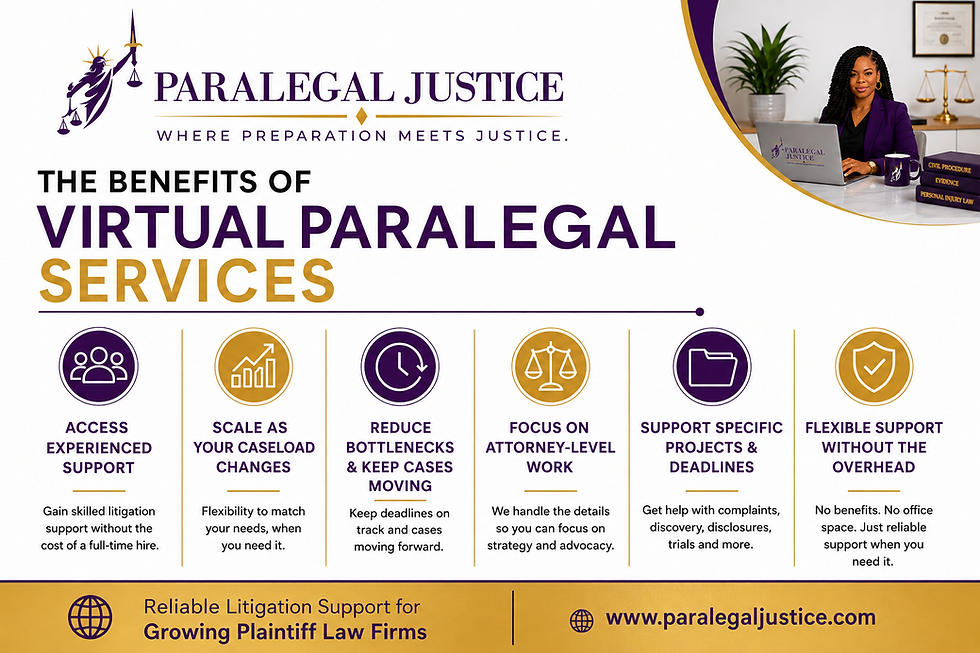
Paralegal Justice provides virtual litigation support to Florida plaintiff law firms handling personal injury and property damage matters. Our services include complaint preparation, discovery responses, initial disclosures, trial preparation, and ongoing case management support.
Where preparation meets justice.


Comments